By Alyssa Nyberg, Restoration Ecologist at The Nature Conservancy’s Kankakee Sands
When I look out over the Kankakee Sands bison pasture this time of the year, not only do I see bison, I also see deer. Sometimes just one deer, sometimes nearly a dozen! Each time I marvel at how small the 150-pound deer look in comparison to the 1500-pound bison standing just a few hundred feet away. Even though smaller than the bison, the white-tailed deer (Odocoileus virginianus) is one of our Indiana herbivores that has a big impact on our hearts, our pocketbooks, our prairies and savannas and sometimes our gardens, too!
To me, deer are gorgeous creatures. I can’t resist those big eyes and long eye lashes. Their large eyes positioned on the side of their head allow them to see predators more easily, especially in low light conditions. Their lean graceful form is built to run 30 miles per hour over long distances, outpacing any predator that might be in pursuit. A mature buck with his massive antlers and deep barrel chest is a powerful, awe-inspiring sight.
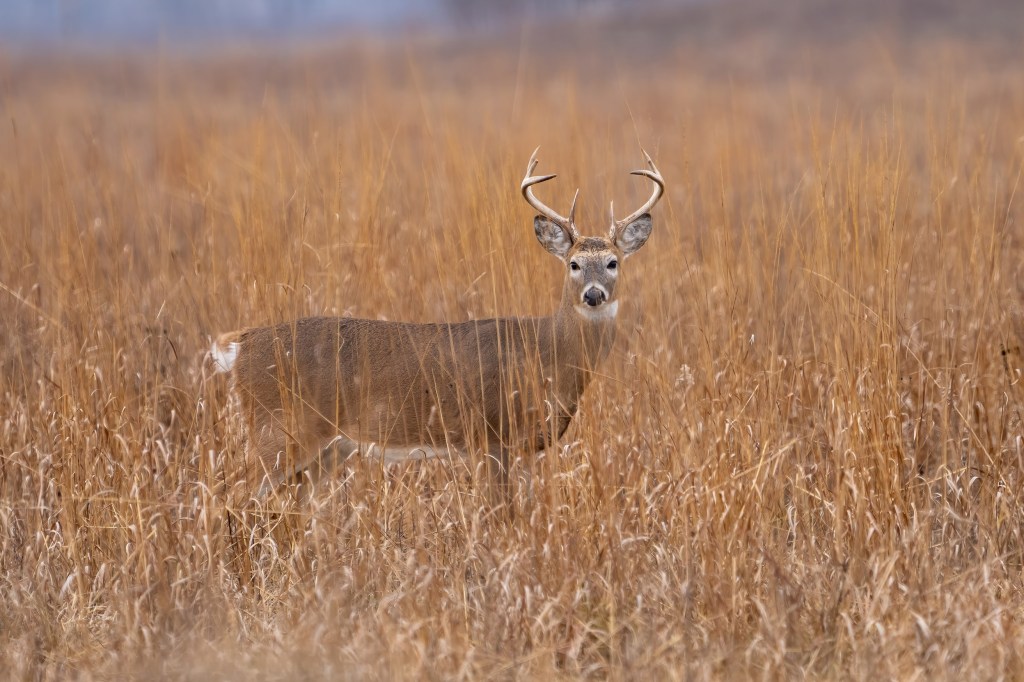
During the winter, the fur of white-tailed deer is grey-brown in color, a subtler hue than their reddish-brown summertime shade. The adorable white-spotted tawny fawns born in the spring have by now also changed in color to a dusky brown color. With these winter coats, the deer are so well camouflaged by their surroundings that one can hardly see them as the deer walk through woodlands, graze in harvested agricultural fields or speed through meadows. If it weren’t for the white underside of their tail that they hold erect in alarm, we might not see them at all.
In Indiana, the white-tailed deer’s breeding season (rut) is typically in late fall. Now that winter has arrived and rut has ended, the male deer (bucks) shed their handsome sets of antlers. In the spring the antlers will begin to grow again.
Historically, white-tailed deer grazed alongside elk and bison, and were prey to bear, cougar and wolves. All of these species, including deer, eventually disappeared from Indiana. Indiana DNR reports that 1893 was the year that the deer were extirpated from the state. For forty years, there were no deer in Indiana. It was not until 1934 that deer began to be re-introduced to Indiana by DNR. Today, the number of deer in Indiana is estimated by DNR to be approximately 700,000.
It’s hard for me to believe there was a time when there weren’t snorts in the distance, crashing of hooves through the leaves and branches, bark rubbed bare by males trying to shed the velvet from their antlers, or even the lone deer standing stalk still except for its twitching ears and nose trying to decide if I am friend or foe – all keeping me company as I walk in the winter. In my lifetime, deer have always been present, and sometimes present in too great of numbers.
Large populations of deer can be detrimental to our natural areas. White-tailed deer selectively graze on nutritious flowers and tree seedlings, making these plants unavailable to pollinators and stripping them of the ability to produce seed and reproduce. Deer consume the tender buds and branches of shrubs and trees, which hinders the growth of the woody plants. Acorns in the belly of deer can’t grow into mighty oak trees. Years of over-browse by deer can lead to a drastic reduction of flower, shrub and tree diversity. In the absence of native vegetation, invasive plant species spread, which only worsens the quality of natural areas.
Overpopulations of white-tailed deer may cause significant damage to agricultural crops as well as garden veggies, and the flowers and shrubs around our homes. Also concerning is that deer are also a host to disease-causing tick species, which present serious health risks to people and pets.
In the 20 years that I have lived in Newton County, I have unfortunately hit four different deer with my car. I’m not alone – DNR reports that 14,000 deer are hit by vehicles annually in Indiana, costing motorists nearly $4,000 per insurance claim*. Ouch!
With such a robust number of deer in Indiana, Indiana DNR manages a deer hunting program at several of its properties to keep deer numbers in better balance.
At Kankakee Sands, we have a hunting program that is managed for us by Willow Slough Fish & Wildlife Area. To hunt deer at Kankakee Sands, a person needs to have a State of Indiana Hunting license and check-in at Willow Slough Fish and Wildlife Area. Deer hunting season in Indiana begins in October and concludes in January. For more information about hunting on TNC preserves, visit nature.org/indianahunting. Please remember that all TNC properties—including Kankakee Sands—are multi-use properties. Should you hike during a hunting season, wear blaze orange to alert others of your presence.
Now that 2024 has arrived, I’ll take the white-tailed deer as my first challenge of the new year to appreciate the complexities of this world we live in and see all sides of an issue. As we know, that is not always easy to do! When I see deer in the bison pasture at Kankakee Sands, I can be thankful that people worked together to return the beautiful, graceful white-tailed deer to Indiana. I can also be thankful to the people that assist in keeping the deer population in check. I can be thankful for all life, and for this beautiful planet we live on.
This January, come out for a drive or a hike at Kankakee Sands. Perhaps you will spot a deer in the distance. If so, enjoy all the thoughts and feelings that the experience provides.
Happy New Year, everyone!
*Purdue University study
______________________________________________________________________________
The Nature Conservancy’s Kankakee Sands is an 8,300-acre prairie and savanna habitat in Northwest Indiana, open every day of the year for public enjoyment. For more information about Kankakee Sands, visit www.nature.org/KankakeeSands or call the office at 219-285-2184.
 Friends of the Sands