By Alyssa Nyberg, Ecologist at Kankakee Sands
Summertime is swimming time in Indiana. Perhaps you enjoy swimming in an outdoor pool, creek or in one of our many Indiana lakes. Image swimming in a 36,000-acre lake! That was Beaver Lake, once the largest lake in Indiana. It was part of the 1-million-acre Grand Kankakee Marsh, a grand wetland ecosystem filled with wildlife of all sizes and types, which was sadly drained in the late 1800s. *
Beaver Lake no longer exists, but the beaver for which it was named sure do! At Kankakee Sands, where wet prairie now exists over the old lakebed, beaver have found a home.
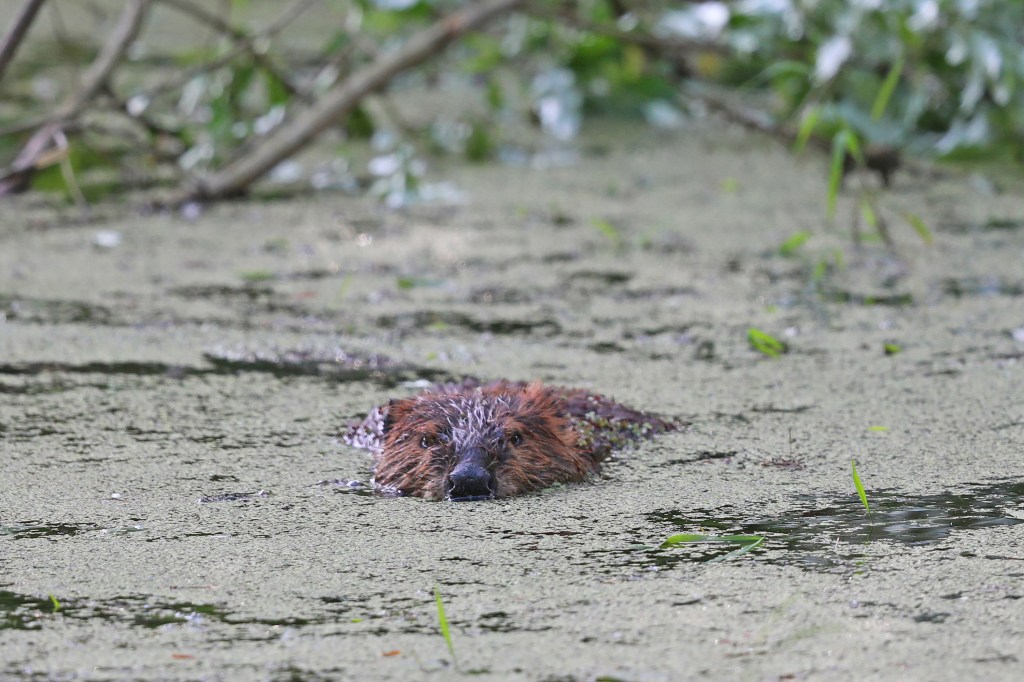
The American beaver (Castor canadensis) is the largest rodent in North America. Would you believe that an adult male beaver can grow to 4.5 feet in length and weigh up to 70 pounds? This large mammal is an underwater wonder! Its eyesight is better underwater than on land. There are protective valves in a beaver’s ears and nose that prevent water from entering when they are swimming underwater. A beaver’s lips close behind their front incisors allowing them to gnaw underwater plant material without taking in water. Their well-known, large, flattened, scaled tail and webbed hind feet are useful for swimming as well as for balancing on soft, muddy ground. And they have thick fur which insulates it from the cold waters in which it primarily resides.
Over the years, beaver pelts have been valued for warmth and fashion. The dense underfur of the beaver was prized by European hatmakers in the late 1500s to early 1800s. It was this demand for beaver pelts that led to the near extinction of beaver in the United States. In Indiana, beaver were reintroduced in 1935, and according to the Indiana Department of Nature Resources, beaver have been able to successfully reestablished across the state.
Beaver are herbivores. Their diet consists mainly of the roots and tubers of aquatic plants, as well as grasses and sedges, and the bark and twigs of woody plants. Beavers act as grazers in wetland habitats. The eating that beavers do helps to maintain a diversity of plant heights and plant species which makes for a healthy wetland. Just like upland prairie habitat is dependent on grazing bison, our prairie wetlands benefit from grazers, too.

Beaver are most active at twilight and night, and so we rarely catch site of them. Instead, we are more likely to notice the mink, muskrat, and river otters that are active during the day. However, at Kankakee Sands we see evidence of the beavers’ presence in the structures that they create. We have seen beaver lodges, 5 feet high and 15 to 20 feet in diameter, where the beaver store food for winter and raise their young. Beaver footprints can be spotted in the muddy shores of waterways. At times we smell the strong scent of castoreum, which they leave on flattened piles of mud to mark territory. And there are a number of small dams made of sticks, mud, and vegetation built along internal ditches.
Beavers create dams along waterways to impede water flow, raise water levels and ultimately protect themselves from land-based predators. At Kankakee Sands, the beavers’ dams also assist with holding water onsite during the summer months, which helps to keep our wetlands wet. Marsh birds, amphibians, turtles and mammals who live in and drink from these pools all benefit from the actions of the beavers.
At Kankakee Sands, the entire prairie ecosystem is important to us, and that definitely includes the beaver. The appreciation and admiration for the beaver is evident in the local Newton County community too – Beaver Township is named for the beaver, the elementary school mascot is the Morocco Beavers, and each May, the town of Morocco celebrated Beaverfest on Memorial Day weekend!
This summer, when you are swimmin’ at your local pool or waterway, remember that along with mink, muskrat, and river otter, the beaver at Kankakee Sands are swimmin’ too!
*The Selling of Beaver Lake, 1853-1889: How the Largest Lake in Indiana Disappeared, by Michael Dobberstein in the Indiana Magazine of History, June 2020.
_______________________________________________________________________________
The Nature Conservancy’s Kankakee Sands is an 8,400-acre prairie and savanna habitat in Northwest Indiana, open every day of the year for public enjoyment. It’s an exciting year for Kankakee Sands, as we are making major improvements to popular areas within the preserve. If you plan to visit, please check our Facebook page to see if any of the areas you want to see will be impacted by the construction. For more information about Kankakee Sands, visit www.nature.org/KankakeeSands or call the office at 219-285-2184.
 Friends of the Sands