By Alyssa Nyberg
Preserve Coordinator, Efroymson Restoration at Kankakee Sands
I’ve never seen a rattlesnake, and that is 110% ok with me! However, I’ll certainly brag about seeing thousands upon thousands of rattlesnake master plants, right here, right now, rooted and growing at Kankakee Sands!
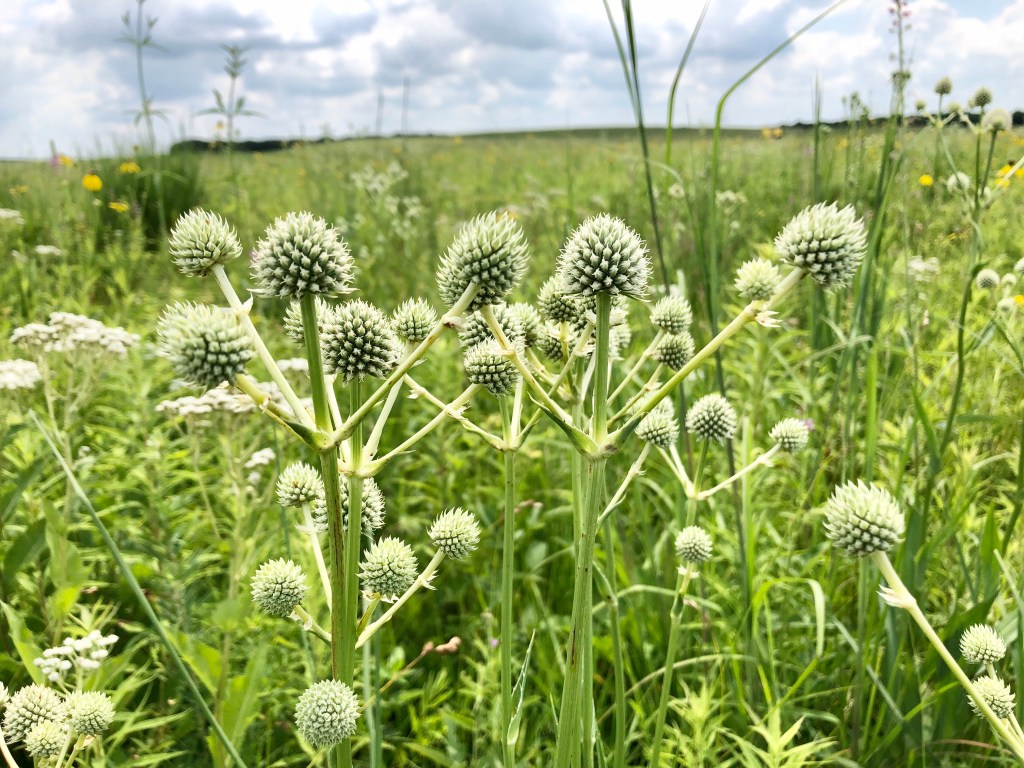
Rattlesnake master (Eryngium yuccifolium) has such a striking appearance that you might think you have never seen anything like it before. However, it is in the Apiaceae family, which means that it is related to carrots, celery, dill and parsley. Like those plants, it has a hollow stem and many small flowers on short stalks that attach at a central point. If you look closely at the flowers, and use your imagination, perhaps you could imagine those tight flowerheads expanding to look like the wide-open flowerhead of a dill plant? At the base of each rattlesnake master plant are long, grey-green 2.5” wide, strap-like leaves with spiny edges. Seeing those leaves, you might be reminded of a yucca plant. Though the two plants are not related, the likeness shows up as a reference in the scientific name of the plant, yuccifolium.
Rattlesnake master typically grows 4 to 5 feet tall, which makes it pretty easy for me–at 5’4”–to admire those gorgeous flowers. The flowers are small, white, 5-petaled and so densely clustered together that somehow more than 100 are packed into one flowerhead! On each plant, there are 20 or so flowerheads. That makes for so many little flowers! The bloom time of the flowers is peak summer, starting in July and continuing through August.
The long-lasting white flowers are loaded with nectar. And because the nectar is located at the base of the shallow flower tubes and easy to reach, it is a favorite of many insects. On a sunny day you can often see a wide variety of beetles, wasps, bumblebees, solitary bees and butterflies–such as monarchs, fritillaries, viceroys, sulphurs and crescents–all feeding at the flowers.
Nectar isn’t the only thing about this plant that is attractive to insects. There are two insects which are completely dependent upon rattlesnake master for their survival. The Eryngium flower-feeding moth (Coleotechnites eryngiella) and the larvae of the Eryngium stem-borer moth (Papaipema eryngii) feed only on the plant material of rattlesnake master. Flower-feeding moths, which consume the seeds of the plant, are well documented at Kankakee Sands. During the evening sheet lighting programs led by Jeanette Jaskula with Friends of the Sands, the Eryngium flower feeding moth has shown up! There is no sign yet, however, of the Eryngium stem-borer which is state endangered in Illinois and state extirpated in Indiana. Jeanette has been able to see evidence of the stem-borer moth in Illinois, however frequent searches for the stem-borer at Kankakee Sands have not been successful yet!
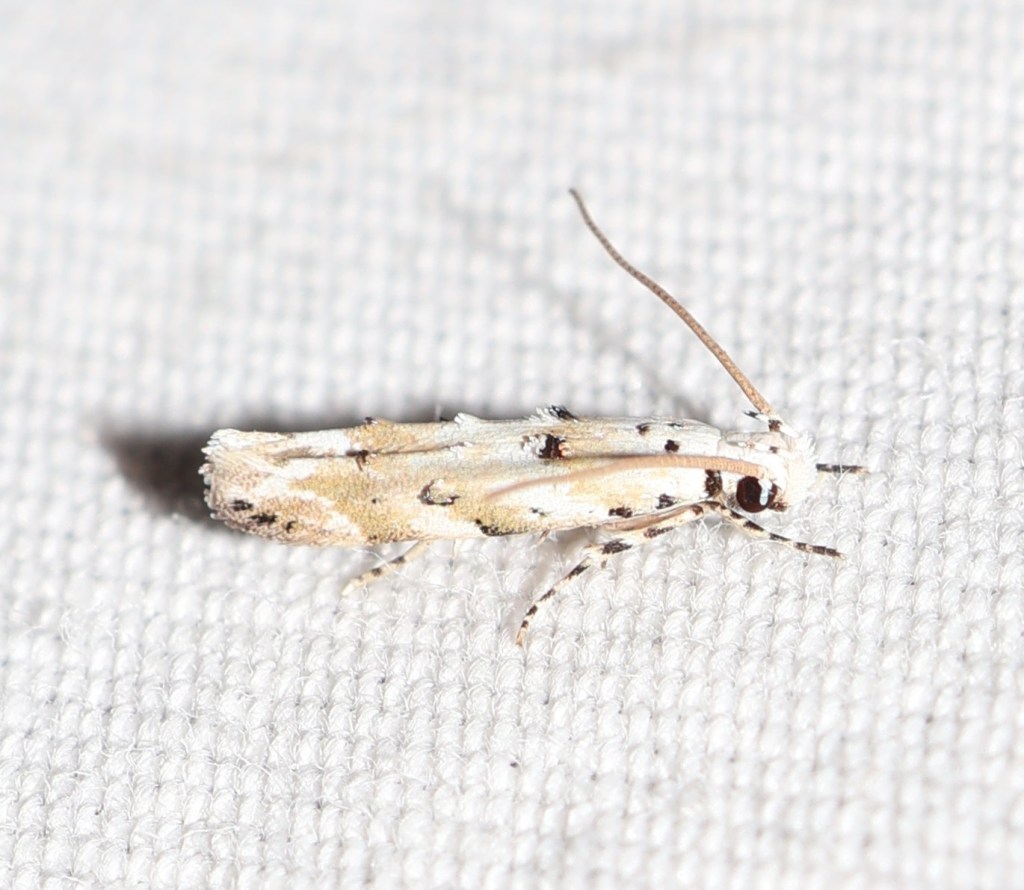
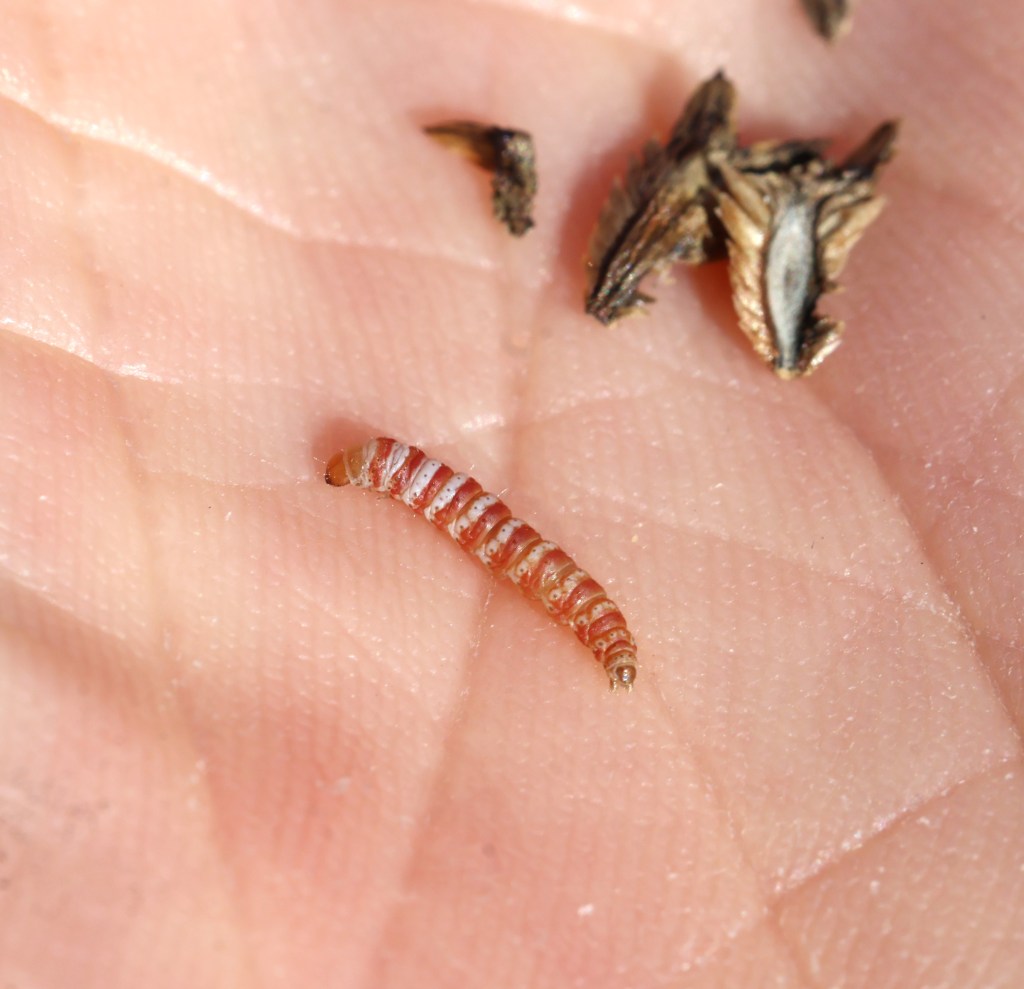
Rattlesnake master is having a banner year here at Kankakee Sands. It is easily visible and in massive abundance in many of our sand prairies. A great place to walk among them, and to get up close and take a look at all the critters dining on them, is on the Meadowlark Trail in the north bison pasture. The one-mile mowed trail is accessible from the Bison Viewing Area.
Considering joining us for an evening sheet lighting event at Kankakee Sands to possibly see the Eryngium flowering moth, and so many other moths! The next Friends of the Sands mothing event is scheduled at Conrad Station Savanna on the evening of Saturday, September 12 from 7 to 9 pm, central time. To find out more, visit https://friends-of-the-sands.com/calendar-of-events/.
_____________________________________________________________________________
The Nature Conservancy’s Kankakee Sands is an 8,400-acre prairie and savanna habitat in Northwest Indiana, open every day of the year for public enjoyment. For more information about Kankakee Sands, visit www.nature.org/KankakeeSands or call the office at 219-285-2184.
 Friends of the Sands