By Alyssa Nyberg, Preserve Coordinator, Efroymson Restoration at Kankakee Sands
Bats are hot these days! If you are a Cubs fan or a White Sox fan, bats are swinging and folks are cheering. If you happen to be an Indiana bat aficionado, then you may have heard that there’s a movement afoot to designate the Indiana bat as Indiana’s state mammal. And with Halloween approaching, bat silhouettes are part of decorations almost everywhere you look.
Shockingly, there are more than 1,500 species of bats worldwide! Forty-five of these are native to the United States and of these, thirteen species of bats have been documented in Indiana over the years. These names are so fun to say: big brown bat, evening bat, red bat, hoary bat, Rafinesqui’s big-eared bat, silver-haired bat, eastern pipistrelle, little brown bat, southeastern bat, gray bat, eastern small-footed bat, northern bat and the Indiana bat.
Though October feels like the month of the bat, in truth many of our bats in Indiana are calling it a wrap for the year and are either migrating or hibernating. Because all of our Hoosier bats are insectivores, feeding only on insects, it seems logical that they would be most active when their food sources are most active—spring to early fall.
Bats typically eat at least half of their body weight in insects each night. A nursing female may eat up to her entire body weight in insects! One study found that a nursing female could consume 4,500 insects in an evening! A bat’s appetite for insects has a very positive economic benefit to the agricultural industry of nearly $4 billion per year! And when you consider that bats are the only major predator of night-flying insects, that is a pretty endearing quality!
I find it fascinating that bats are the ONLY mammal to fly. They are a mammal which has mastered the air! And by relying on echolocation, rather than sight, they have also mastered the night! In bats, flights and echolocation seem to have co-evolved, making them true masters of the night sky!
A bat’s uniqueness makes it a great candidate for Indiana’s state mammal. Although Indiana bats are typically found in forested areas, rather than prairies like those of Kankakee Sands, I still think it is a wonderful choice! Both the Indiana DNR and The Nature Conservancy have excellent webpages on the Indiana bat (Myotis sodalis), with interesting information all about the species and including the most adorable and amazing photos of the animals roosting together. Visit fws.gov/species/indiana-bat-myotis-sodalis and nature.org/Indiana to learn more.
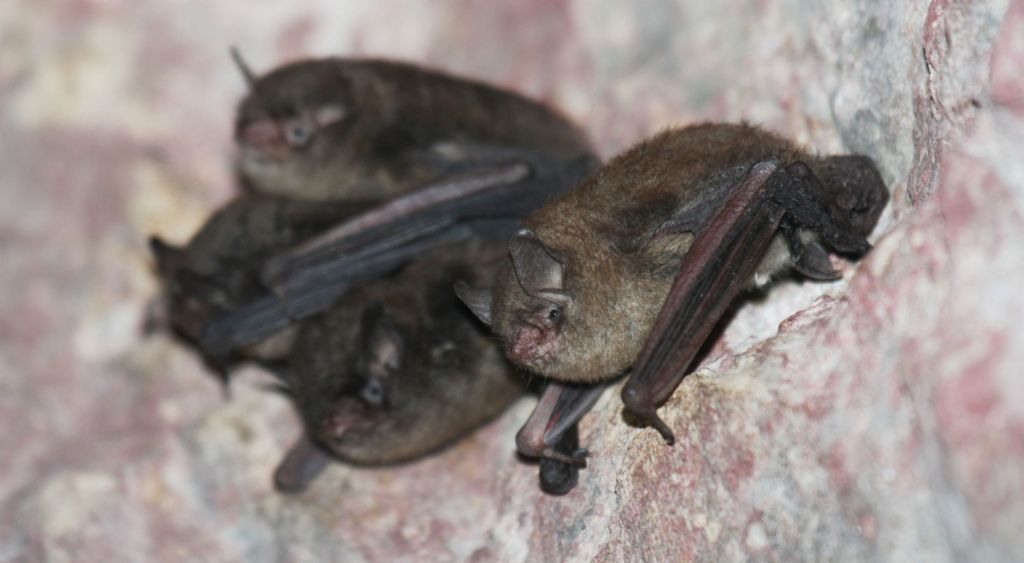
I first fell in love with bats back in 2019 when a small bat took up residence in the rafters of the Kankakee Sands Seed Barn. I noticed a bit of poo on the concrete, and when I looked up, there was little ball of fuzz nestled in the rafters high above. I was never able to get near enough to confirm which species it may have been —it could have one of the bats that commonly roost in buildings, such as the big brown bat or the little brown bat, rather than the others which roost in trees amongst the bark and leaves. However, the little bat was back again this year joining me in the seed barn in the summer and just left this past week. One day, perhaps I’ll figure out which species it is! Perhaps it is one of the bats documented at Kankakee Sands, such as the big brown bat, hoary bat, red bat, or little brown bat. Or perhaps it will turn out to be one that we haven’t yet documented!
Most bats in the Midwest hibernate from late October through April, which mirrors insect abundance! The Indiana species of bats that hibernate in caves are the Indiana bat, the little brown bat, the northern bat, the eastern pipistrelle, and the big brown bat—who is known to also hibernate in buildings. All other bats migrate south to warmer areas in late fall.
There are several actions you can take to ensure that bats are a forever part of our summer-time night skies. Of great importance is preserving and creating more habitat in the form of woodlots for bats to roost, raise their young, and feed. Incorporating more native flowering plants into gardens to attract moths and night flying insects—the very food that many bat species love to eat – is another beautiful and useful way to encourage bats! In our northwest Indiana area, native plants such as wild bergamot, rose milkweed, rattlesnake master, tall ironweed and prairie blazing star are great options. Remember, bats eat up to half of their body weight in insects each night, so the midnight munchies for them are real!
On the evening of Saturday, October 24, Friends of the Sands will be hosting a Conrad Moonlight Hike along the 1.6-mile mowed trail at Conrad Station Savanna Nature Preserve in Newton County. Will we see the night sky? Yes! Will we see the full moon? Yes! Will we see bats, the masters of the night sky? That my friends, is the exciting question. Come join us and find out! For more information about the hike and to RSVP, visit nature.org/events.
____________________________________________________________________________
The Nature Conservancy’s Kankakee Sands is an 8,400-acre prairie and savanna habitat in Northwest Indiana, open every day of the year for public enjoyment. For more information about Kankakee Sands, visit www.nature.org/KankakeeSands or call the office at 219-285-2184.

